ChiangRai, History and You
Some comments on matters frequently overlooked, to provide better context for understanding the societies of the Golden Triangle region, utilizing some excerpts from my new novel, “Going to Laos”.
Because the world has changed so fast of recent, many people consider the past almost insignificant, and, relative to modern technologies, unimportant. But the past is the only context we have through which to gain the informative perspective on things which we need to have. As has been said before, we cannot know where we are, if we don’t know how we got here.
750 years ago Mengrai came to ChiangRai, and settled in a town which became named after him. Historians say he “founded” ChiangRai, but as there was already an established town, with temples, markets, and surely some form of government, it might be better should say he transformed it.
History is only semi-rigorous, half almost scientific, half of it’s about opinion. Who “started” a war? Was King Taksin, who ruled just before the beginning of the Chakri Dynasty, crazy, and if so, when did he become crazy? Was Burma part of India, just because it was also a British colony? Did the USA “defeat” the Soviet Union in the “Cold War”? One cannot prove most answers to questions like these to be correct, or much more than opinion.
Not so long ago, history was regarded mostly as the chronicles of the acts of kings, great military generals and other leading men. Then, some people started to notice that women were often of real significance too. And that human events have been determined as much by disease and other natural events, commerce, ideas, and even fashions. The people of Easter Island cut down all their trees to put up huge stone effigies - which apparently was a fashion, as it served no known functional purpose. And the lack of trees resulted in most of Easter Islanders dying. A strange history, but history still.
Mengrai made a decision to come here, and that decision was important, perhaps the most important decision in all the history of Southeast Asia. Had Mengrai not done what he did, Chinese troops under Mongol leadership surely would have brought the Lanna area into the Yuan Empire. Disease may have played an important role; it isn’t known for a fact, but seems likely that the demise of the great Angkor Empire was rooted in the Black Plague, something which arose because of the success of the Mongols, but something which they surely didn’t intend. Rats carrying disease-infested fleas were able to travel further and faster, due to Kublai Khan’s success in promoting commerce, through, among other things, building roads. The rats got on ships, and eventually almost half of the people living in the well-populated parts of Europe died - from the Bubonic, or Black, Plague. This may well have happened in Angkor also; we have little other information to explain their sudden loss of strength. It’s very clear, though, that without both the fall of Angkor and Mangrai’s success at blocking Mongol incursions into what is now Thailand, Ayudhaya could not have so quickly arisen to the importance it did, becoming, for a while, perhaps the most populous city on our planet.
So, history, although about people, is about diseases, too. It’s also about natural events like floods, earthquakes, volcanoes, meteors and violent storms. As the 3rd decade of the 15th century CE went on, weather became significant in Lanna history, when King Sam Fang Kaen was fighting Jeen Haw from the Yunnan area. Lightning struck and destroyed the Haw headquarters, killing their chief and many others, and allowing a Lanna victory. At about the same time, another lightning strike destroyed palaces of the newly completed Forbidden City in Beijing, leading to Ming isolationism. The lightning may well have suggested to many that he’d lost the “Mandate of Heaven” and so made a change of important policy essential, in order that the Emperor at least appear to win that mandate back.
History is about everything which affects us, about commerce and invention, ideas, fashion, the arts and even the games we play. Need I mention the significance of last eyar’s floods, or the desire of so many to gamble?
King Ramkamhaeng promoted a wide commerce in Sangkalok pottery, beautiful glazed ceramics, containers and dishes, while he was king. Sangkalok style pale blue or off-white porcelain with designs of flowers, foliage and fish painted beneath the glaze, were made at Sukhothai’s sister city Si Satchanalai and later, Kampaeng Phet. Most were bowls and plates, but some sangkalok ware was used for architectural decoration; much was exported to countries throughout Asia (mostly to China, but even to Japan, the Philippines and Indonesia), making Sukhothai the center of a trade empire and perhaps the most important producer of ceramics in Southeast Asia for over two centuries. Many examples are in museums throughout Asia. But while similar ceramics made in ChiangRai were of much better quality, they never became famous. How did that happen? Perhaps because beauty and grace don’t mix well with business? About this, and many other things, you can decide for yourself. Certainly, I’d like to know, but don’t. Somlak Pantibun, who makes world-class pottery at Doi Din Daeng, near Ban Pa-O, east of Highway 1, would surely like to know more about that too!
The last king of Lanna, Phra Mekut (Mah Ku or Mekhuti, ruled 1552-1564) died in the area which has become Myanmar, at Pegu or Ava, and the people there revere his spirit as a powerful Nat, Yun Bayin, #22 of the 37 widely believed in Myanmar to protect the country. Nats are an important part of Burmese culture, and represent spirits so troubled by misdeeds, so horribly, tragically dis-ordered by extreme complexities from violence, lust, greed, and other unfortunate realities, that it cannot return through the cycle of re-birth, and must remain earth-bound. Mekhut’s problems, among other things, involved the levy of taxes so heavy, and rules for conscription into the military or doing of unpaid labor, things so demanding and onerous, that the people became rebellious. Surely that consequence was unintended, unless Mekhut wanted a Burmese invasion, but intended or unintended, actions do have consequences, which we learn about through history.
Through the kind of spiritualism that gave rise to the Yun Bayin Nat, which we can see as an idea, we can have some understanding of what happened to Lanna, understanding we most likely wouldn’t have otherwise, as so many records have been lost. There are good records of Lanna, but they leave many things confused. Mengrai is said to have had two wives, but we have three names for them: Eua Ming, Rai Koma and Usa Payaki. How did that happen? Quite a lot, if not most, of the historical records of neighboring countries have been lost, some due to politics, some due to the leaves they were written on rotting from humidity. So it is good that we can learn other ways, and from other places.
To really know about Lanna, one must know about Mengrai, Pra Makut, and also the Burmese General Burengnong (or Bayinnaung) and the wars with Burma, which went on from the middle 1500s CE until 1825 (about 2100 BE to 2368), just as to really know about the language used by locals here, one must know of the Tai Yai in Shan State, and the speakers of an ancient Tai dialect, with written characters, who live near Luxi and Ruili in what was once southern Nanchao, at the western tip of Yunnan, China, in what has now become called Deihong Dai or the JingPo Nationalities Autonomous Prefecture. People from Bangkok used to call Kham Muang “Lao”, but it is as different from most Lao as it is from the Central Thai pasa klang. Similarly, ChiangRai has always been different from ChiangMai – and only history can explain this.
Similarly, the Lanna area has always been different from the central plains area of ChaoPraya River drainage, as much so as Issan is different from the Thai peninsula. North of ChiangMai, the once ubiquitous Siamese sampan was of little utility; Brahaministic influence has been small, social stratification and cultural antipathies much less, and resistance to centralized control much more. But a quarter century of the Lanna area’s history has mostly disappeared, due to needs felt by advocates of centralized control.
Fortunately, we aren’t totally dependent on written chronicles for learning history. Not only the study of language but excavations, textiles, personal collections and even tree rings have offered a lot that has helped develop insights. But much Thai history remains unclear: who was here before T’ai people came, and how much did the introduction of Thai language change things? How many different migrations to here from China were there, and what all was affected by them? Much about the strange history of opium use here remains unclear, as does much about the political use of buffer states (rat gan chon, or muang pradhesa raja). Were people to better understand history, misunderstandings about politics, business, religion and how best to speak properly might make for less problems, and respect for valuable resources, art and literature might come more easily to people not generally inclined to think about matters like those.
Northern vs. southern Muslims (the northern ones failed to protect when a mosque proposed for the MaeKaJaan hot springs roadside tourist trap was vehemently protested by locals, in part because the traditional Islamic community was Chinese, many of the newer ones from Bangladesh, and recent relocates from the south were mostly spirited businesspeople with no more intention of riling up or alienating locals than the others, and little more interest in the tourists the mosque was supposed to make feel more welcome), the opening up of Myanmar, Who Benefits from the last gasp of the credit economy flooding Cambodia and Laos with electronics, resource depletion and increased cost of living from inferior products mostly from China, too many New-Years and elections, casinos, money-laundering shops, schemes and scams. Inflation, half of the stores getting low on stock or going out of business while others prosper (or appear to prosper; in ChiangRai, a three block stretch of one street had nine opticians, three of those branches of the same company (which also had two more within a block of each other on a nearby street, and more elsewhere in the amphoe), and all sold reading glasses at a couple thousand baht, while TescoLotus sold them at 200 and at street-stalls they’d fetch as little as 50…).
So, an interesting divide: northern Islamic traders, noodle eaters accustomed to mountains and working with non-Islamic town-folk and power-brokers, Chinese language and bureaucracy, tribal peoples and beasts of burden vs. southern Muslims, rice-eating descendents of people who’d lived under the Raj British empire, mostly in low-lands, and suffered grievous strife with non-Islamic people of the same empire… And an interesting parallel: TehChiew and other Thai central plains Chinese vs. Jeen Haw, the Islamic descendents of ancient Silk Road traders, who, rather than speaking one of the many, many Chinese dialects, speak something fairly close to central Mandarin, but trust Beijing even less, the Bangkok elite not at all, and other outsiders but little. For a long time we had made some use of them, but these cultural divides, and desires for distinctive identities, can be tricky, indeed.
Although Myanmar’s Naypyidaw government tries to control trade in precious and semi-precious stones, they can’t. Much of the country has never been controlled, and perhaps never will be. It’s been said that only opium funded the guns of resistance, but it’s just not so. Manufactured goods smuggling, rubies and jade, religion, prostitution, gambling, racketeering and information-selling have always been part of it. Weaponry is expensive, and drug production is the small potatoes at one end of that trade. But young men do get guns, which is all any of the common people do get from international trade. Perhaps as much as half of resistance weaponry is received free, contributed for political, religious or more nefarious reasons. Without such help, resistance would have collapsed, despite the value of goods available to trade. For, in the circumstances, trade is only chaotically managed, fraught with corruption and deceit, with pricing at great variance from the norm. Without the guidelines of social convention or much in the way of adherence to written law, business isn’t just a risky proposition, it’s absolutely perilous. Most hunting in northern Myanmar is still done with home-made bullets; lots of fishing is done with home-made bombs. Even petrol sales tend to be done clandestinely. Nothing small is traded except at morning vegetable markets, and what is traded cannot be tightly controlled.
Burma was never a country in the modern sense, but rather an elaborate series of interlocked obligations, agreements, exchange traditions and mutual defense agreements. There had been many royal courts, before colonization, with one more powerful that the others, but local affairs were dominated by local chiefs. Consequently, after the end of World War II and independence, local militias became so common they could hardly be counted. Methods for remaining competitively armed became equally elaborate, armaments procured through a wide variety of methods, of which opium was for a few decades the most obvious. Many of the “defense forces” were hardly well armed, but only at great peril could their territory be traversed without permission. Trade was tricky; some went on anyway. Especially for guns, bullets and explosives – paid for however possible. If not opium, or amphetamines, then information, trickery, food stuffs, forest product, promise of alliance (including religious alliance), and precious stone. Chinese weapons obtained by the Wa might end up on Kachin hands, Kachin jewels in Shan hands, and information on government materials movements in anyone’s hands. Competition, and rivalries, often internecine, were fierce.
In his 2009 book, “The Art of Not Being Governed, An Anarchist History of Upland Southeast Asia”,
James C. Scott gives a name to the mountainous region of South East Asia comprising parts of Myanmar, Cambodia, China, India, Laos, Vietnam, and Thailand: Zomia. He claims that the people of the highlands of Zomia have lived outside the reach of lowland governments for millennia, although things have changed for many of them in the last 50 years. Scott argues that those living in the highlands, rather than being just tribal remnants of primitive societies, consciously choose to live outside the reach of the state. In providing an alternative to the common view that those living outside the state are uncivilized, Scott’s analysis makes the important point that the nation state is not synonymous with order. What he apparently misses is the relative weakness of most of those raised on agriculturally-based state societies. Few of them could ever successfully adapt to the rigors of jungle, tribal existence; fewer still would even be accepted.
Also, when people wanted to escape the corrupt, US-sponsored South Vietnamese governments, did they go live with Montagnards, to Laos, or to highland tribal societies of Cambodia? No, they became boat people, or went to PhnomPenh. I don’t think Muslims from India went to highland, Tribal areas of Pakistan or Bangladesh after Partition, either. Nor have but a few of the millions of Chinese who immigrated to Thailand gone to the hills – those that were mostly soldiers who stayed as a group of Chinese, well-connected to Taiwan. Nice of James Scott to try to improve the image of purported “barbarians”, but really, they’re no more refugees from “civilization” than they’re wannabee Americans. Which isn’t to say that people seldom want to escape the manipulations of government, or church, family or whatever – they often do, and one result of this well be a new round of attempts to secede from the central government in a few years, when that has become allowed under their new constitution.
Nations derived from city-states, which came to be because of necessities involved in storage, and trade. Armed forces are hardly as much for protection of territory as they’re for protection of group capacity for trade. Government’s prime function is to protect trade, not only for food security, but to maintain a sufficiency of necessities for the polity, against the likelihood of attempted depredations by others. Trade is about us versus them – about one group benefitting from another. It’s about the existence both of occasional abundance and the regularity of scarcity. The nation is a new idea, as ideas, rather than inventions, go. It’s really of but half a millennium’s duration. Before that, there were centers away from which power gradually weakened, and trading empires. Armed resistance to disruption of trade has gone on for over five millennia; protection of trade capacity long precedes the nation, and is, in fact, the root of our capacity for civilization.
The new situation in Myanmar, while glittering with potential profit, is clearly rife with economic peril. That’s something many Japanese investors learned about, painfully, a decade ago. The billions of the first wave of international investment in China after Deng opened things up were mostly been lost, and I see little reason not to anticipate a repeat performance with Myanmar “opening up.” The Kanchanaburi pipeline didn’t transport gas (or anything else) to Thailand for years following completion; the universities were closed or dysfunctional for decades, infrastructure remains minimal or less, and yet there are all sorts of shiny new banks. The famous jade mines in the north, filthy, open sores with thousands of desperate, out-of-control, heroin-addicted workers infected with HIV and no hope of medications, plus gunmen everywhere, should serve investors as a warning, but likely won’t.
Natural medicines factories purportedly producing ancient forest-product remedies have almost no quality control, those producing them, on-line in the factory, are often meth-addicted and of ridiculously poor hygiene. Over 200 corpses per week, more than an average of one per hour, go unidentified in Thailand, and the situation is far worse in Burma. Per population, it’s as bad elsewhere in Asia. Many of the deceased meet their deaths for political reasons, which can usually also be called economic ones. A few result from love, lust and anger, but these kinds of murder tend not to be as well arranged. Most result simply from someone being in the way of someone unprincipled and ruthless.
Here in Asia the big challenge is to rise high in the “patronage system”. Money from drugs (illegal or not), human trafficking (for adoption, pederasty, prostitution, refugees or organ harvesting), counterfeiting (currency and goods), illegal gambling venues, pimping and prostitution, various forms of theft and tax evasion, and, most particularly, political graft (bribery, black-market armament sales, padded purchasing and various other scams and rake-offs) all need to be washed before they can be profitably invested and retired in luxury on, so money-washing has become part of the patronage system too. It’s not just those recognized as “criminals” who do these things - the “silent services” do them, as do many judges, most politicians, almost all law enforcement agents (certainly in this country, at any rate), many too-clever bureaucrats, and even computer hackers.
Long ago, the Thai patronage system, then called sakdii-na, and pretty much like the European feudal system, had under-lords and overlords, and one direct master for each individual. Loyalty is a commanding virtue, and exists because it is bought. But recently, the Thai system, now rabop khwam oop-pa-taam, has changed to allow a variety of patron backers: if you want, say, to start a business or do something that requires a bit of bureaucratic manipulation, your various patrons (pu-soop oop-pa-taam) will make calls, signs checks, bang or butt heads, and get in touch with connections on your behalf. They expect, in return, a show of gratitude and good manners in the form of “tea money” gratuities, political loyalty and an appropriately kraing-jai (afraid of offending) attitude. It’s pretty simple, and efficient.
Might not a ski resort in Myanmar’s northernmost province, Kachin State, as Taksin Chinawat proposed, possible make good money? Yes, perhaps, if the cost of security matters somehow doesn’t need to be an issue. How about a Club-Med type facility or two in the islands? Well, sure; maybe with some budget hotels with minibus service between them to service those interested in ancient ruins, tribal peoples and beautiful Inlé Lake, definitely. In India they raked in money through spiritual “instruction”… possibilities there… Halliburton had done well with food services for employees; possibilities there too. Some might see it as too bad that a Blackwater thing wouldn’t be possible, but with about half-a-million armed men spread throughout, well, never-mind that. Real manufacturing? Slowly, slowly. Mineral extraction? That’s what was calling to the big money, but what was possible right away would be just too crude. And the people of “Zomia” remain difficult to deal with.
Not long ago, descendents of Dr. William Briggs of Overbrook Hospital came to visit, after contacting me for help finding their way around. I found people very glad to meet them! More recently, a shop-owner in the USA also contacted me, about wanting to sell some things which had belonged to Dr. Briggs, including his personal seal. This seal is quite like seals used with opium. This is suggestive of how many ideas about opium came from the British (Dr. Briggs was from Canada, a British colony, although his descendents are citizens of the USA. In Dr. Briggs’ time, the British were very important in this area due to their cutting lots of teak in the general area, and having a consulate in ChiangMai). The strange histories of opium, over-exploitation of natural resources, and the system of buying positions in governmental bureaucracy, the military or police, deserve much more attention, for the sake of solving pressing problems. History can also help one understand why Siam could resist European colonialism while so few else could, and why Europeans were able to think so highly of themselves from about 1500 CE until not very long ago. The history of where you live can foster respect for where you live.
Despite Dr. Briggs and government efforts, development in ChiangRai proceeded but slowly until the 1990s. The economic crash of 1997 put an end to hopes for many poorly-thought-out construction projects here, but in the last decade there’s been considerable growth. With growth, new problems replace old ones, and traffic, air and noise pollution, garbage, inflation and long waits for health-care are growing problems. Understanding of history may or may not help with these things, but it will certainly take knowledge to solve the problems, and not just knowledge of business. Only people with general knowledge will be able to think up new solutions.
In a quickly changing world, information is perhaps our most important resource. Without new information, we certainly cannot survive as well as we’d like. It is not enough to just believe; we need respect for knowledge, and understanding that knowledge is not constrained by written words. Some history gets lost, but sometimes lost things get found, too.
There’s much history in the world, and one can hardly learn it all, but to know one’s self, one must know at least some of the history which made you what you are. Only knowledge of the past can help one decide best about the future, and only history confirmed through a variety of sources can be considered knowledge.
Meanwhile, people who’ve never been disciplined or denied become too quick to anger, petty in recriminations and spites, pompously full of pretentions, unproductive, selfish, self-absorbed, self-centered, self-deluding, self-serving, lacking in self-awareness, small-minded and disdainful, demanding, mean-hearted, cruel, immature, irresponsible, morally weak if not immoral, scornful, pugnacious, provocative, contentious, back-stabbing, fashion-addicted and begging for trouble, have become common. The well-heeled and well-connected, too often too busy to provide all the personal involvement their children need, try to compensate for lack of attention through lavishing undue entitlements, which the children come to expect and indeed demand. In their consequent arrogance, uncontrolled young men relish thoughts of becoming violent with impunity, and having a kind of revenge on the world. To gain some excuse to lash out, they’ll provoke others, not only insolently refusing to adhere to societal norms, but cultivating angles of defiance to them.
One of the many things one tends to learn in Asia: life’s not about changing the world. It’s about relationships, what you can change in yourself, and keeping a cool heart, jai yen-yen. A few get to pretend to be big, often through no doing of their own, but mostly simply through lucky circumstance (if it really is luck, as being “big” has drawbacks too). The only ones who really get to accomplish much must be flexible, adapt, don’t ever publicly act over-excitable and even in private don’t let things seriously upset them. Ones that have to prove themselves just end up embarrassed, eventually losing face and stature. A few, kids of the rich and powerful, are allowed to grow through that when young, to make mistakes and then learn and grow from them, but, like the investors who will surely throw away lots of money in Myanmar, many will only learn from painful mistakes. Maybe that’s necessary, maybe not. History needn’t be boring, but can be a good, edifying story, helpful towards better decision making. If only we will let it be so.
Sunday, September 2, 2012

Friday, June 15, 2012
Historical revisionism?
Before me is a strangely interesting little brochure from the Chiang Rai Municipality: “guide 9 Temple Route”. I don’t know where it came from (and I don’t know where it’s going), but it both intrigues and annoys me. “For more information about these routes and free bicycle rentals, Please contact the Tourist Information Center behind King Mengrai Memorial” it says, sounding quite well-intentioned. “Worship Buddha images” it also says, plus “Worship Phaya Mengrai stupa” and Worship City Pillar”. Now we’ve all encountered interesting mis-translations, or mis-transliterations (“Fried crap” etc). That’s not what really gets me.
Wat Phra Keaw was founded as “Yarukhavanaram” – OK, maybe so. Not what I read on the temple’s own sign, but really, I don’t know. Wat Phra That Doi Jom Thone “was built by Phraya Reun Kaew in 940” (AD, or CE, more appropriately, I suppose). Interesting. We know so little about things that far back around here. “Also, the Ratanakosine 108 city pillars, which are in the pattern of the universe” (sic)… well, again, subject to interpretation, I guess. I was strongly under the impression that there was but the one city pillar, but I could’ve been misinformed. “The interesting thing about the chedi of Wat Jet Yod is that it is in the same Indian style that is found throughout Chiang Mai.” Learn something new every day, almost.
“Wat Ming Mueang is located on Trirat Road, Amphoe Muang, Chiang Rai. The temple is Thai Yai style. It was built in 1262 by Queen Maha Tevee Usa Payaki, King Mengrai’s wife.” Again, maybe so. I don’t know. On 10 August, 2011, I posted: “Yesterday I heard an interesting story: when Good Father Mangrai was settled into ChiangRai, he met Princess Eua Ming Wiang Chai, of ChiangSaen (Yonok, or whatever it was called then) and wanted to marry her. She insisted on a promise that he would then take no other wife. He gladly agreed.
“But when much older, after a successful campaign against the Burmese and tired of fighting them, negotiations for peace included a traditional offering of Princess Pai Koma in marriage; he decided to accept. Queen Eua Ming, distraught, withdrew to a nunnery, in anguish and grief so strong that it infected a great storm, and later died there. It was gossiped about that the broken promise, and her broken heart, produced the lightening that struck Mangrai down and ended his life.” (Well, I just discovered a couple typos, one pretty big, and corrected them).
So, three wife names for Mengrai (I’m told “King Mengrai” is redundant as Meng means king, but as should be apparent by now, I’m told many things). Eua Ming, Rai Koma and Usa Payaki. None are mentioned in the ChiangMai Chronicles. So who knows? I became interested in local history after being asked to teach it, and noticing many contradictions and absurdities in what I was asked to teach. Many of my students noticed these things too: when I did as told and instructed them that Ramkamhaeng’s father was a fisherman, several lost it and fell out of their seats, rolling around the floor in hilarity. I was impressed. Perceptive kids, those 12-year-olds.
Somehow, I think that with that, I’ve said enough.
ChiangRai History
ChiangRai, History and You
Because the world has changed so fast, many people consider the past almost insignificant, and relative to modern technologies, unimportant. But the past is the only context we have, through which to gain the informative perspective on things which we need. We cannot know where we are, if we don’t know how we got here.
750 years ago Mengrai arrived here, to a town which became named after him. Historians say he “founded” ChiangRai, but as there was already an established town, with temples, markets, and surely some form of government. Perhaps it might be better should say he found ChiangRai. Or transformed it.
History is only half a science. Half of it’s about opinion. Who “started” a war? Was King Taksin, who ruled just before the beginning of the Chakri Dynasty, crazy, and if so, when did he become crazy? Was Burma part of India, just because it was part of the same British colony? Did the USA “defeat” the Soviet Union in the “Cold War”? One cannot prove answers to questions like these to be correct, or much more than opinion.
Not so long ago, history was regarded mostly as the chronicles of the acts of kings, great military generals and other important men. Then some people started to notice that women were often of real significance too. And that human events have been determined as much by disease and other natural events, commerce, ideas, and even fashions. The people of Easter Island cut down all their trees to put up huge stone effigies - which can only be called a fashion, as it served no functional purpose. And the lack of trees resulted in most of them dying. A strange history, but history still. Mengrai made a decision to come here, and an important decision it was. Perhaps the most important decision in all the history of Southeast Asia. Had Mengrai not done what he did, Chinese troops under Mongol leadership surely would have brought the Lanna area into the Yuan Empire. But I suspect that disease may have played an equally important role. It isn’t known for a fact, but does seems likely that the demise of the great Angkor Empire was rooted in the Black Plague, something which arose because of the success of the Mongols, but something which they surely didn’t intend. Rats carrying disease-infested fleas were able to travel further and faster, due to Kublai Khan’s success in promoting commerce, through, among other things, building roads. The rats got on ships, and eventually almost half of the people living in the well-populated parts of Europe died - from the Bubonic, or Black, Plague. This may well have happened in Angkor also; we have little other information to explain their sudden loss of strength. It’s very clear, though, that without both the fall of Angkor and Mangrai’s success at blocking the Mongol expansion, Ayuddhaya could not have so quickly arisen to the importance it did, becoming, for a while, perhaps the most populous city on our planet.
So, history, although about people, is about diseases, too. It’s also about natural events like floods, earthquakes and storms. As the 3rd decade of the CE 15th century went on, weather became significant in Lanna history, when King Sam Fang Kaen was fighting Jeen Haw from the Yunnan area. Lightning struck and destroyed the Haw headquarters, killing their chief and many others, and allowing a Lanna victory. At about the same time, another lightning strike destroyed palaces of the newly completed Forbidden City in Beijing, leading to Ming isolationism. The lightning may well have suggested to many that he’d lost the “Mandate of Heaven” and so made a change of important policy essential, in order that the Emperor at least appear to win that mandate back. Need I mention the threat of floods facing us right now? History is about everything which affects us, about commerce and invention, ideas, fashion, the arts and even the games we play.
King Ramkamhaeng promoted a wide commerce in Sangkalok pottery, beautiful glazed ceramics, containers and dishes, while he was king. Sangkalok style pale blue or off-white porcelain with designs of flowers, foliage and fish painted beneath the glaze, were made at Sukhothai’s sister city Si Satchanalai and later, Kampaeng Phet. Most were bowls and plates, but some sangkalok ware was used for architectural decoration; much was exported to countries throughout Asia (mostly to China, but even to Japan, the Philippines and Indonesia), making Sukhothai the center of a trade empire and perhaps the most important producer of ceramics in Southeast Asia for over two centuries. Many examples are in museums throughout Asia. But while similar ceramics made here in ChiangRai were of much better quality, our local product never became famous. How did that happen? Perhaps because beauty and grace don’t mix well with business? About this, and mnay other things, you can decide for yourself. Certainly, I’d like to know, but surely don’t. Somlak Pantibun, who makes world-class pottery at Doi Din Daeng, near Ban Pa-O, east of Highway 1, would certainly like to know more about that too!
The last king of Lanna, Phra Mekut (Mah Ku or Mekhuti, ruled 1552-1564) died in the area which has become Myanmar, at Pegu or Ava, and the people there revere his spirit as a powerful Nat, Yun Bayin, #22 of the 37 widely believed in Myanmar to protect the country. Nats are an important part of Burmese culture, and represent spirits so troubled by misdeeds, so horribly, tragically dis-ordered by extreme complexities from violence, lust, greed, and other unfortunate realities, that it cannot return through the cycle of re-birth, and must remain earth-bound. Mekhut’s problems, among other things, involved the levy of taxes so heavy, and rules for conscription into the military or doing of unpaid labor, things so demanding and onerous, that the people became rebellious. Surely that consequence was unintended, unless Mekhut wanted a Burmese invasion, but intended or unintended, actions do have consequences, which we learn about through history.
Through the kind of spiritualism that gave rise to the Yun Bayin Nat, which we can see as an idea, we can have some understanding of what happened to Lanna, understanding we most likely wouldn’t have otherwise, as so many records have been lost. There are good records of Lanna, but they leave many things confused. Mengrai is said to have had two wives, but we have three names for them: Eua Ming, Rai Koma and Usa Payaki. How did that happen? Quite a lot, if not most, of the historical records of neighboring countries have been lost, some due to politics, some due to the leaves they were written on rotting from humidity. So it is good that we can learn other ways, and from other places.
To really know about ChiangRai, one must know about Mengrai, Pra Makut, and also the Burmese General Burengnong (or Bayinnaung) and the wars with Burma, which went on from the middle 1500s CE until 1825 (about 2100 BE to 2368), just as to really know about the language used by locals here, one must know of the Tai Yai in Shan State, and the speakers of an ancient Tai dialect, with written characters, who live near Luxi and Ruili in what was once southern Nanchao, at the western tip of Yunnan, China, in what has now become called Deihong Dai or the JingPo Nationalities Autonomous Prefecture. People from Bangkok used to call Kham Muang “Lao”, but it is as different from most Lao as it is from the Central Thai pasa klang. Similarly, ChiangRai has always been different from ChiangMai – and only history can explain this.
Fortunately, we aren’t totally dependent on written chronicles for learning history. Not only the study of language but excavations, textiles, personal collections and even tree rings have offered a lot that has helped develop insights. But much Thai history remains unclear: who was here before T’ai people came, and how much did the introduction of Thai language change things? How many different migrations to here from China were there, and what all was affected by them? Much about the strange history of opium use here remains unclear, as does much about the political use of buffer states (rat gan chon, or muang pradhesa raja). Were people to better understand history, misunderstandings about politics, business, religion and how best to speak properly might make for less problems, and respect for valuable resources, art and literature might come more easily to people not generally inclined to think about matters like those.
Not long ago, descendents of Dr. William Briggs of Overbrook Hospital came to visit, after contacting me for help finding their way around. I found people very glad to meet them! More recently, a shop-owner in the USA also contacted me, about wanting to sell some things which had belonged to Dr. Briggs, including his personal seal. This seal is quite like seals used with opium. This is suggestive of how many ideas about opium came from the British (Dr. Briggs was from Canada, a British colony, although his descendants are citizens of the USA. In Dr. Briggs’ time, the British were very important in this area due to their cutting lots of teak in the general area, and having a consulate in ChiangMai). The strange histories of opium, over-exploitation of natural resources, and the system of buying positions in governmental bureaucracy, the military or police, deserve much more attention, for the sake of solving pressing problems. History can also help one understand why Siam could resist European colonialism while so few else could, and why Europeans were able to think so highly of themselves from about 1500 CE until not very long ago. The history of where you live can foster respect for where you live.
Despite Dr. Briggs and government efforts, development in ChiangRai proceeded but slowly until the 1990s. The economic crash of 1997 put an end to hopes for many poorly-thought-out construction projects here, but in the last decade there’s been considerable growth. With growth, new problems replace old ones, and traffic, air and noise pollution, garbage, inflation and long waits for health-care are growing problems. Understanding of history may or may not help with these things, but it will certainly take knowledge to solve the problems, and not just knowledge of business. Only people with general knowledge will be able to think up new solutions.
In a quickly changing world, information is perhaps our most important resource. Without new information, we certainly cannot survive as well as we’d like. It is not enough to just believe; we need respect for knowledge, and understanding that knowledge is not constrained by written words. Some history gets lost, but sometimes lost things get found, too. There’s much history in the world, and one can hardly learn it all, but to know one’s self, one must know at least some of the history which made you what you are. Only knowledge of the past can help one decide best about the future, and only history confirmed through a variety of sources can be considered knowledge.
Monday, March 19, 2012
Another Nam Lad occupation.
Even tribal villages are adjusting rapidly to new ways, while valuable, sustainable old ones fade. Not three years ago, Ban Nam Lat had two elderly broom-makers; now it has only one. Nai Pan Satda, of 111 Ban Nam Lat mu 3, Thanon MaeFahLuang Soi 3, ChiangRai 57—(tel 053-150-127) makes big brooms for outside use year round, of coconut leaves (bai maprao) and bamboo. The selling price recently went up from B40 to B50. In the cool season, November to January, he makes house brooms, B20 before, B30 now. These are made with brushes from dok kong, which grows wild, and can be seen drying on streets many places in Amphoe MaeFahLuang during the cold season, especially by Akha people, who gather it for brooms, but usually only attach bamboo handles for their own use, selling the brushes wholesale.
Prettier brooms with decorative stitching are made elsewhere, for instance out Chiang Rung way.


Nai Pan's son Jarusak Satda, runs Northern Most Point Audit, an accounting firm, out of their home, and raises beautiful carp, similar to if not the same as Japanese koi.


The lower pair of brooms were made near Nang Lae; B110 retail for the pair!
Prettier brooms with decorative stitching are made elsewhere, for instance out Chiang Rung way.
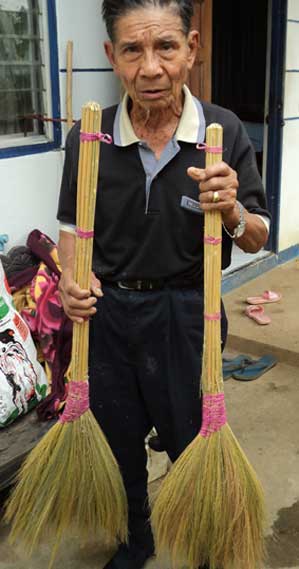


Nai Pan's son Jarusak Satda, runs Northern Most Point Audit, an accounting firm, out of their home, and raises beautiful carp, similar to if not the same as Japanese koi.


The lower pair of brooms were made near Nang Lae; B110 retail for the pair!
Tuesday, February 28, 2012
Musings on the local economy of Amphoe Muang, ChiangRai
This morning I visited friends who’ve opened a yoga teaching shop-front in what was called Ban Du Muang Mai, just east of NamTong Road, where there are “Walking Street” open-air market activities on Sunday and Tuesday evenings. I asked about the empty area east of the end of their street (the street directly across from that of Chiangrai Rajapat University Gate #1). They said that that area will become an Old-Folks home for Japanese, and part of the proposed expressway from China, now already somewhat in operation.
This led to discussion of our real-estate bubble. Not 3 years ago, my wife and I bought 3.5 rai of land for 1.36 million baht. Now land prices in Amphoe Muang are a minimum of a million baht per rai. So my wife wants to buy more land. I’d just as soon buy gold.
OK - land prices tend to rise, but haven’t they gone down recently, in lots of places? Aren’t the economic “fundamentals” of lots of places coming heavily into question? Is business with China really going to flow, even flood, through here?
#1 - Chinese products are cheap in two ways, price and quality. I, personally, don’t want most of them anymore, and I’m hardly alone in that.
#2 - with Myanmar opening up, vehicular traffic through from MaeSot to India becomes a real possibility.
#3 - this immediate area is flush with money right now, but much of it is casino, drug and prostitution related, and there’s good reason to question whether that can last.
#4 - the Old-Age Home idea is a good one, except that there are problems with the quality of help available. A decade ago, some Japanese Yakusa wanted to build one, but then backed off.
#5 - MuBan Omsin, and the housing projects by the 2nd MaeSai bridge remain largely empty, so why expect that all these new tiny dwellings are going to turn a profit?
#6 - the US may well import much less from China soon, hurting the Chinese economy, most of which is on its eastern seaboard anyway. Yunnan isn’t very industrial, and with gas prices rising, trucking all the way here isn’t going to be competitive with shipping. Going across Laos involves a variety of complications, including bureaucratic, logistic and infrastructure ones (the hard-top currently needs re-surfacing yearly, and when trucks break down, the road can get blocked, among other things).
Maybe money from Bangkok will continue to flow to here, or maybe they’ll finally admit to the necessity of moving government somewhere else, and that money will change in destination to wherever that will be. And another year of devastating flooding is hardly going to help the Thai economy!
Just thought I’d say…
Saturday, February 25, 2012
Karen pole dancers and other shots from Colors


addendum
Lahu dancers and drummers:


Thai-digerees-do:

Locals in "chut-parjam-pao" (Palaung or Paduang, not sure):

Ongsasin Rhythm, from Central Thailand:

Chianghai World Colors 750 years
Just back from the World Colors @ Chiangrai thingy where the hilltribe houses from the Flower Festival still are. Long-time resident of Thailand, singer Todd Tongdee Lavelle, originally from Scranton, PA USA, was MC - he's been on many a Thai stage for well over 2 decades, speaks Thai quite well. Sunday the 26th is the last day, with School Shows starting at 6 pm, Ongsasin Rhythm at 7 then Hmong Superstar, World Colors of Lahu, Dara-ang, PuTai and Kamu... Punjabi Academy dance troop from India, and lastly, at 10:30 a Farewell Jam.
In all, nicely weird, with a tiny yurt, a teepee made of crepe or something, a Thai on digereedoo, a Lakota hoop dancer/flutist who's accent was quite White by me... some interesting write-ups (including about Lanna trade with Mongolia - I'd LOVE to see evidence of THAT!!!), and lots of food, handicrafts and drinks. Oh, and Karen kids were doing a neat dance between moving bamboo poles. Plenty of parking, all free.
couldn't get a photo of the Karen kids on here. will post again...

Kevin Locke, Lakota

something I'd love to see evidence of

children of the yellow leaves (OK, not exactly Mlabri, as from South Thailand, but physically similar)

ugga-wugga-wigwam

TaiYai-Kinaree
Subscribe to:
Posts (Atom)